Spiking Neural Networks: When Timing Is the Signal
SNNs make time and sparse events part of computation. Their engineering value depends on the encoding, workload, and hardware together.
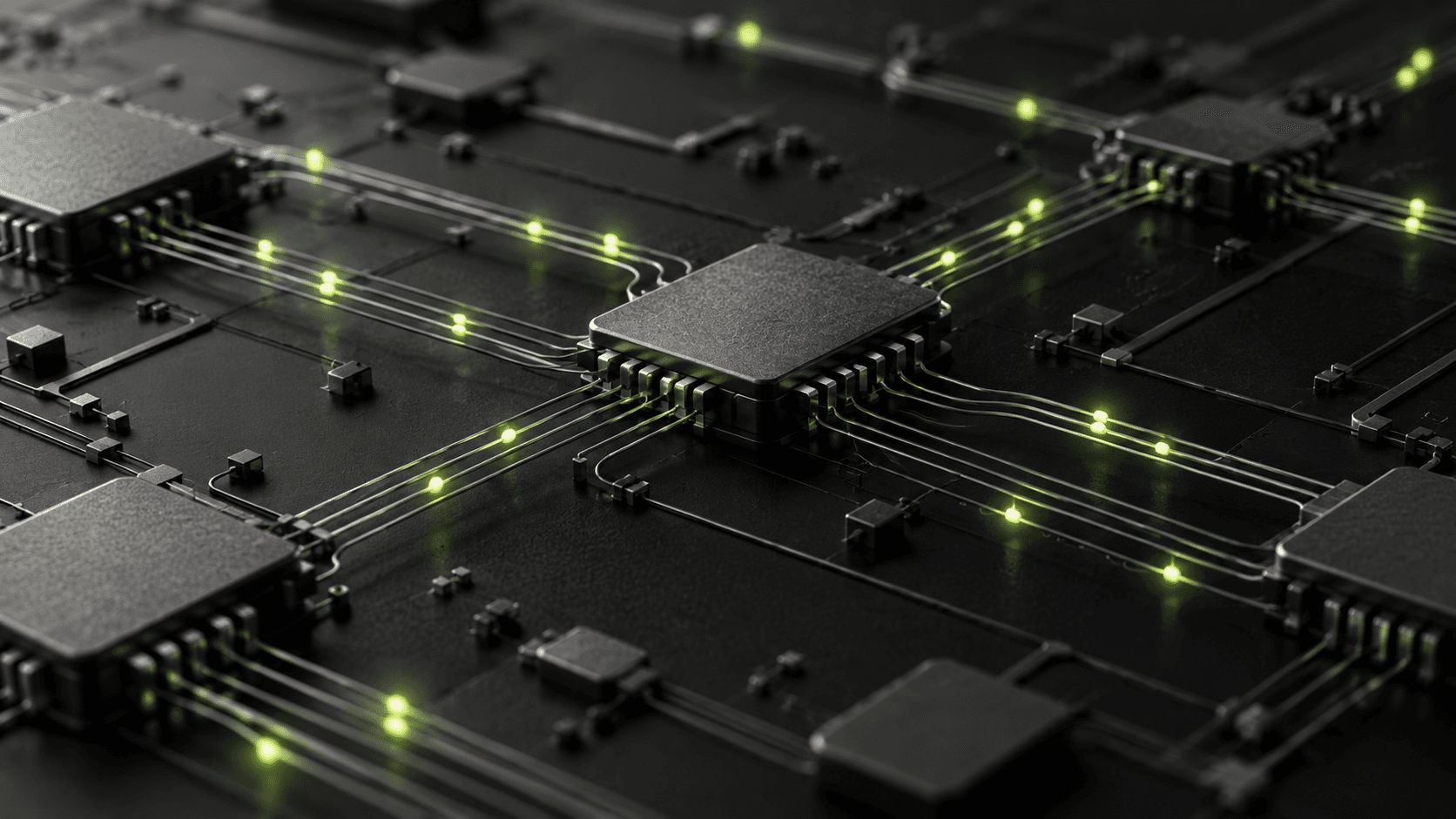
Most familiar neural-network implementations process continuous-valued activations in dense tensor operations. Spiking neural networks introduce a different computational vocabulary: internal state evolves over time, and neurons communicate through discrete events.
This is attractive for signals where timing matters. It also creates a practical question that cannot be answered from a neuron diagram: does an event-driven representation improve the complete system under its real accuracy, latency, memory, and power constraints?
What a spiking neuron actually changes
A common starting point is a leaky integrate-and-fire neuron. Incoming activity contributes to an internal membrane-like state. That state decays over time; when it crosses a threshold, the neuron emits a spike and its state is reset according to the chosen model.
The useful distinction is not that SNNs are biological brains. They are artificial computational models inspired by selected aspects of neural dynamics. Their behavior depends on the neuron equations, time discretization, connectivity, and encoding scheme.
Information may be represented through spike counts, precise timing, temporal patterns, or population activity. Those choices create different delays and tradeoffs. A rate-coded system that needs many timesteps to produce a stable answer may sacrifice some of the latency advantages suggested by sparse communication.
Training through discrete events
A thresholded spike does not provide the smooth derivative used in ordinary backpropagation. One widely used training approach keeps the discrete forward behavior and substitutes an approximate derivative during the backward pass. This is a surrogate gradient, not an exact derivative of the spike function.
The snnTorch tutorial and perspective paper explains connections between deep-learning optimization, spike encoding, and temporal credit assignment. It is a practical foundation for understanding what changes when a network carries state across timesteps. Other approaches include ANN-to-SNN conversion and local learning rules; each makes different assumptions about data, accuracy, and hardware.
Why neuron dynamics remain an active research topic
A 2025 Nature Communications study on adaptive spiking neurons examines how adaptation and numerical discretization affect temporal processing. Its results highlight that the neuron model and its implementation can matter alongside network depth or width. Those task-specific findings should not be generalized into a claim that every adaptive SNN outperforms every conventional network.
A 2026 review of neuromorphic neurotechnologies also reflects continued interest in low-power, closed-loop processing. That research context is a reason to investigate suitable workloads, not proof of a universal efficiency advantage.
Energy efficiency is a system property
Sparse events can reduce work on hardware designed to exploit them. A dense GPU simulation of an SNN may still perform substantial computation at every simulated timestep. Input conversion, memory access, communication, and idle power can also affect the total.
Therefore, a spike count is not an energy measurement. A fair comparison should identify the hardware, measurement boundary, decision latency, workload, and achieved accuracy. An impressive chip-level result cannot simply be copied onto an unrelated software deployment.
For an event-camera or vibration-monitoring experiment, I would compare an SNN with a suitable temporal ANN baseline using the same held-out operating conditions. The experiment should include the cost of encoding inputs and producing a final decision, not just the neural core.
An evaluation plan worth trusting
- Hold out complete recordings or operating runs to avoid temporal leakage.
- Compare time-to-decision as well as eventual classification quality.
- Vary the timestep count, encoding, firing activity, and neuron time constants.
- Measure memory and end-to-end power on the intended device when making efficiency claims.
- Test how missing events, timing jitter, background activity, and changed event rates affect predictions.
SNNs are especially interesting when the sensor, task, representation, and deployment hardware all benefit from temporal sparsity. For a dense static dataset on conventional hardware, a well-tuned ANN may remain the better baseline. The research question is which information and computation can be preserved while performing fewer operations, and whether that reduction survives outside a simulator.
Sources and further reading
- Training Spiking Neural Networks Using Lessons From Deep Learning, tutorial and perspective
- Advancing spatio-temporal processing through adaptation in spiking neural networks, Nature Communications 2025
- Towards neuromorphic neurotechnologies, npj Biomedical Innovations 2026 review
Research perspective. Sources checked on 20 October 2026; no hardware energy measurements are claimed for this portfolio.