A Provider-Neutral LLM Gateway Is Not an API Proxy
Stable aliases, explicit policy, observability, and testable fallbacks turn model calls into infrastructure.
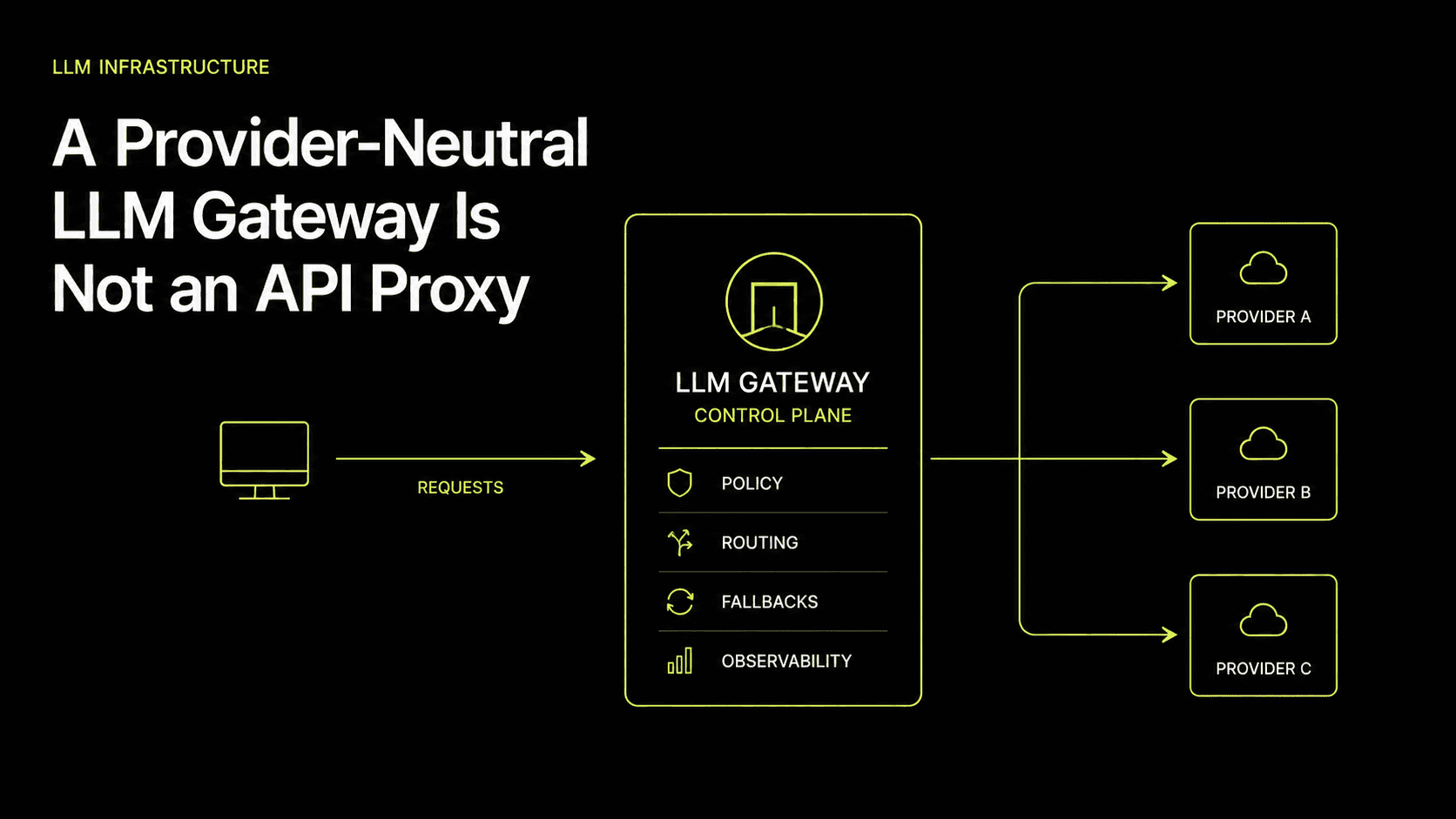
A provider-neutral LLM gateway is not an API proxy
Calling a model directly from an application is a good way to learn. It is not usually a durable production boundary. As soon as a product has multiple features, providers, cost constraints, or reliability expectations, every call site starts making slightly different choices about timeouts, retries, schema handling, and logging.
An LLM gateway exists to make those choices explicit once.
Start with a stable product contract
The application should ask for a capability, not a provider-specific model string. For example, fast classification, careful analysis, and vision extraction can be product aliases that map to a policy-controlled provider and model. That gives teams room to change the implementation without rewriting every feature.
The gateway contract should normalize inputs, structured outputs, tool definitions, streaming events, and usage data. It should also preserve useful provider details in a safe diagnostic field instead of pretending every provider behaves identically.
Routing is policy
Good routing considers more than availability. A request may need a particular modality, a low latency profile, data-handling constraints, a constrained cost envelope, or a verified structured-output capability. Make those requirements machine-readable at the boundary.
Then keep fallbacks narrow. A fallback model should be compatible with the response contract and safety expectations. "Try anything else" is not a resilience strategy. It is a way to create surprising behavior under load.
Treat retries as a budget
Retries help with transient failure, but every retry consumes time, quota, and sometimes duplicate side effects. I prefer a short request budget with bounded attempts, jitter, cancellation propagation, idempotency where supported, and a clear final error class. Tool calls deserve even more care because replaying a write is not equivalent to replaying text generation.
The Responses API streaming reference is useful context for this: streamed interaction is a sequence of stateful events, not one blob of text. A gateway should preserve that lifecycle so product teams can handle partial output and failure honestly.
Observability is the real payoff
At minimum, record request type, selected alias, resolved model, latency, token or usage metrics, retry count, tool usage, finish reason, and a trace identifier. Avoid logging sensitive user content by default. The goal is operational evidence, not a private transcript archive.
This makes questions answerable: Did a route change increase latency? Is an expensive alias used for low-value work? Are schema failures concentrated in one feature? Is a fallback hiding an upstream incident?
Keep the adapter layer small
The provider adapter should translate transport details. It should not become the place where business rules drift. Keep shared policy in the gateway, adapters focused on capability translation, and application code focused on the user task.
The outcome is not vendor avoidance for its own sake. It is an application that can evolve models, preserve a consistent product contract, and explain what happened when a call does not go as planned.
What the gateway actually owns
The LLM API Gateway presents a normalized FastAPI contract for chat, schema-constrained output, and embeddings. It resolves a stable alias to an ordered provider and model chain, checks the requested capability, applies a timeout, and records the attempt. Gemini and OpenAI adapters translate to and from their SDK-specific payloads; routing policy stays above them.
That boundary is useful because it keeps application code from learning provider response shapes. It also makes the failure path visible. Rate limits, timeouts, and transient server failures are retryable. Invalid requests and unsupported capabilities are not. The gateway retries the current route with bounded exponential backoff and jitter before moving to the next configured provider.
Key idea. A final success is incomplete operational information if the first route failed. The gateway persists failed attempts as well as successful ones so the fallback path remains inspectable.
Usage is not billing
The gateway normalizes input, output, and cached-input tokens, then applies a local pricing catalog to produce an estimated-cost field. That is intentionally an estimate, not invoice reconciliation. Provider billing tiers, cache rules, and product pricing can differ.
Each usage event carries a request ID, alias, provider, model, latency, retry index, status, normalized usage, and estimated cost. It is enough to answer engineering questions such as whether a fallback occurred, whether a route is producing transient errors, or whether a feature is using an unexpected alias. It is not a substitute for tenant isolation, quotas, or production authorization.
Limits that stay outside the gateway
The gateway does not make fallback models semantically equivalent. It does not make a local development usage endpoint safe to expose publicly. Before a multi-tenant deployment, authentication, authorization, client quotas, rate limits, secret management, and tenant-aware accounting are separate product and security decisions.