Physical AI: From Perception to Closed-Loop Action
Robotics foundation models and simulation are advancing quickly. Reliable physical AI still depends on sensing, control, evaluation, and recovery working together.
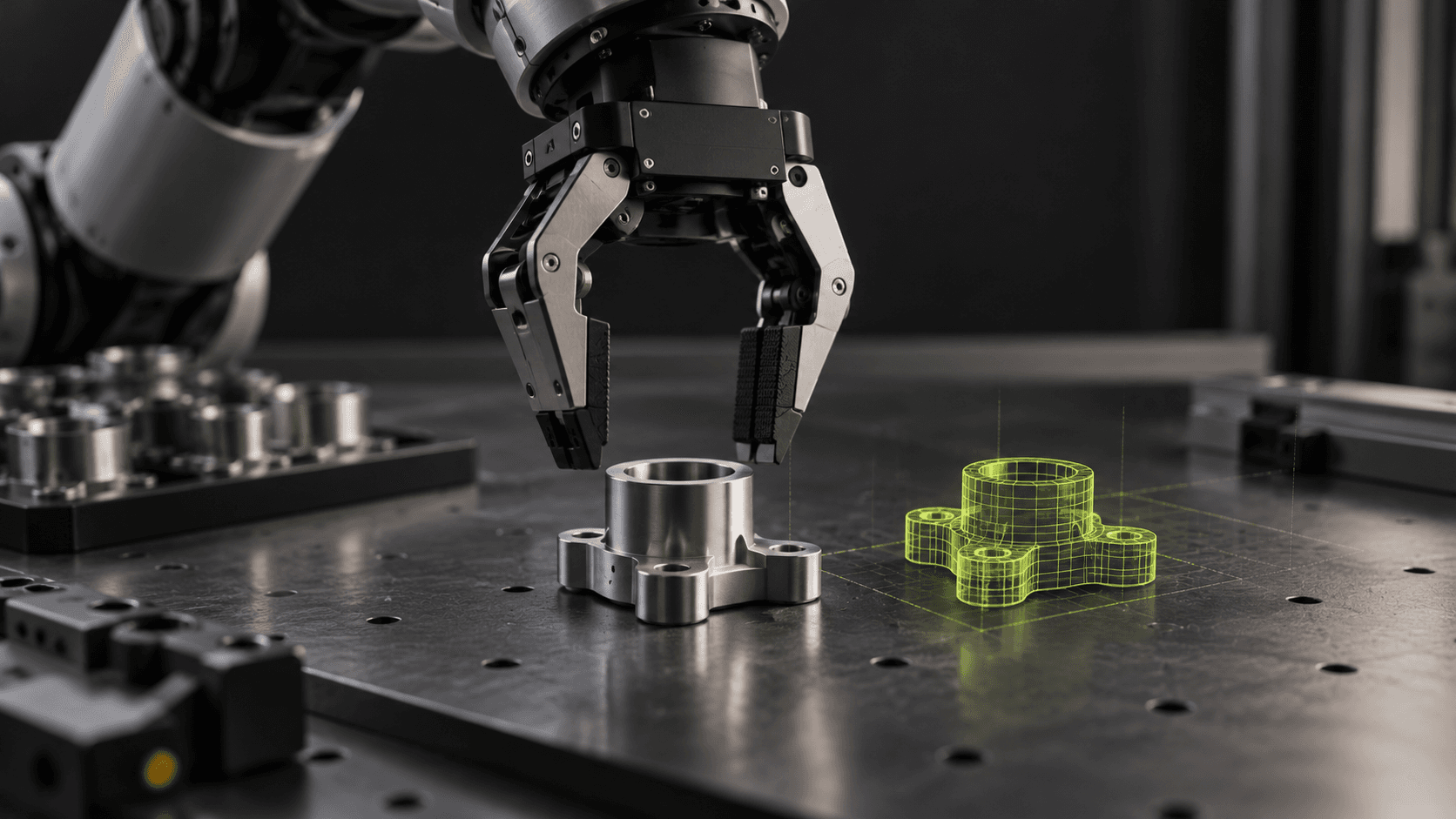
A language model can describe how to move a part. A physical system must locate the part, estimate its state, choose a motion, execute it within mechanical constraints, and observe what happened. The difference is a feedback loop that runs through the real world.
Physical AI is a broad term for AI systems that perceive, reason about, or act within physical environments. Robotics is a prominent example, but the engineering questions also appear in industrial autonomy and embodied sensing. The term should not be confused with physics-informed AI: one describes an application setting, while the other describes ways to incorporate physical knowledge into learning.
Why vision-language-action models matter
Vision-language-action, or VLA, models connect visual observations and language instructions to action generation. They offer a route for transferring broad learned representations into tasks that require motor behavior.
The GR00T N1 paper, published as a 2025 preprint, describes a humanoid foundation model combining a vision-language component and a diffusion-based action component. The Gemini Robotics research report also investigates bringing multimodal reasoning into robotic interaction. These are examples of research directions and reported evaluations, not evidence that arbitrary robots can reliably perform arbitrary instructions.
The July 2026 NVIDIA GR00T development workflow is interesting beyond an individual checkpoint. It connects demonstration collection, simulation, policy training, evaluation, and deployment. That integration reflects an important practical constraint: a capable model is only one part of a usable robotics development process. Vendor documentation describes its own stack and should be evaluated in that context.
The real interface is observation to action
An action policy consumes an imperfect view of the world. Cameras can be occluded, measurements arrive at different times, and coordinate frames can disagree. By the time an action is executed, the object or robot may already have moved.
A useful system contract therefore specifies sensor timing, calibration, state representation, control frequency, action units, and the boundary between high-level planning and low-level control. Without that contract, an apparently reasonable action can be wrong for the actual hardware.
For a pick-and-place example, success is not merely producing a plausible grasp. The system must approach without collision, establish contact, retain the object, place it within tolerance, and detect whether the operation succeeded. Recovery from a dropped or misplaced part belongs in the task definition.
Simulation helps when the gap is measured
Simulation makes it possible to generate scenarios, replay failures, and vary conditions without repeating every experiment on hardware. Digital twins can provide useful geometry and system context. Synthetic demonstrations can extend coverage.
The simulation-to-reality gap remains an empirical question. Friction, compliance, backlash, sensor artifacts, lighting, and contact behavior can differ from the simulator. Randomizing parameters can help explore uncertainty, but the chosen ranges may still omit the conditions that matter.
Test transfer in stages: validate perception, compare estimated and measured motion, evaluate a bounded skill, then expand the operating conditions. Keep simulation results distinguishable from hardware results throughout reporting.
What a defensible evaluation includes
Long sequences compound errors. A policy that usually succeeds at one short action may still fail a task requiring many dependent actions. Aggregate success rates also hide differences between objects, conditions, and failure severity.
- Define the task's initial conditions, completion criteria, and allowed interventions.
- Separate familiar objects and scenes from held-out objects, layouts, and instructions.
- Record complete-task success, retries, recovery behavior, latency, and physical constraint violations.
- Preserve synchronized observations, actions, and outcomes so failures can be replayed.
- Evaluate the bounded operating envelope before expanding autonomy.
Independent control limits, supervised validation, and reliable stop behavior are system requirements when physical actions can damage equipment or affect people. A language prompt should not be the only mechanism defining those limits.
Where this connects to industrial AI
Industrial monitoring can support the perception and state-estimation side of physical AI without directly commanding a machine. For example, a research model might identify an unusual operating pattern and request inspection. That is a different claim from an autonomous controller changing the process in response.
Keeping those roles distinct makes progress easier to assess. The strongest physical-AI projects show what the system observes, what it is permitted to do, how it handles a failed action, and what was demonstrated on real hardware. Impressive motion is a useful demo; repeatable closed-loop behavior under stated conditions is the engineering result.
Sources and further reading
- GR00T N1: An Open Foundation Model for Generalist Humanoid Robots, 2025 preprint
- Gemini Robotics: Bringing AI into the Physical World, 2025 research report
- Develop Humanoid Robot Policies End-to-End with NVIDIA Isaac GR00T, July 2026
Research perspective. Sources checked on 20 October 2026; the cover is a conceptual illustration and no robot deployment is claimed.