Modern Neural Networks: Beyond the Architecture
From ANNs and attention to state-space models and hardware-aware kernels, useful progress comes from matching the model to the problem.
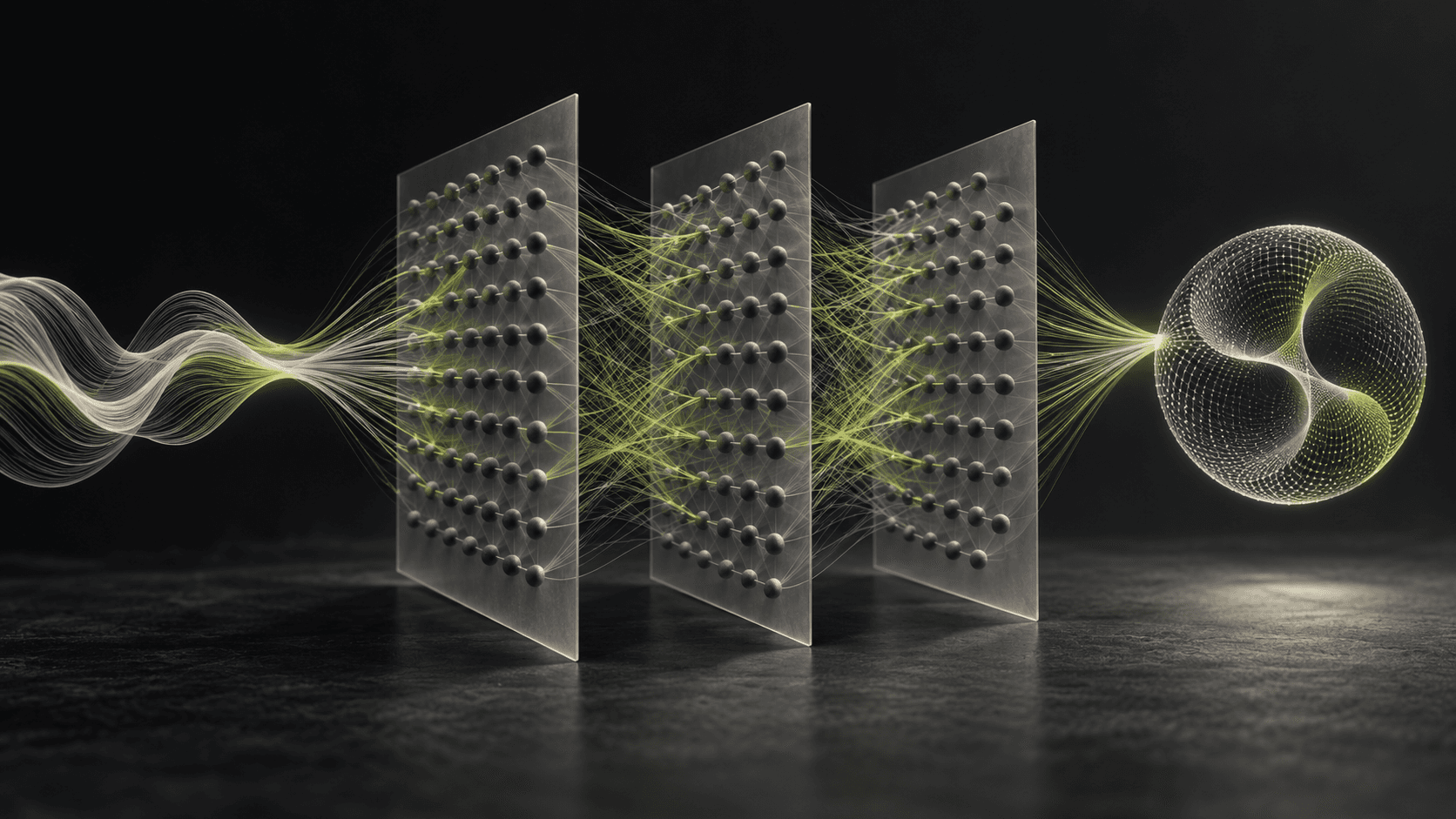
Artificial neural networks are often introduced as layers of connected neurons. That picture is useful, but it hides the decisions that determine whether a model is valuable: what information it receives, what structure it assumes, what its objective rewards, and how it behaves when the input changes.
The practical question in modern deep learning is less about choosing the newest diagram and more about choosing an appropriate computation. A network for a vibration signal, a visual inspection system, and a long-document language model can share optimization tools while requiring very different architectures and evaluation plans.
ANNs are a family, not one architecture
An ANN is a parameterized computational model that learns transformations from data. A multilayer perceptron combines weighted features through nonlinear layers. Convolutional networks reuse local filters, making locality an explicit assumption. Attention lets positions interact according to learned content. State-space models maintain a structured evolving state for sequences.
These approaches are not cleanly separated generations that replace one another. They offer different inductive biases, memory requirements, and implementation tradeoffs. Spiking networks also belong to the broader family of artificial neural models; their distinction is their event-based communication and temporal dynamics.
The Mamba-2 paper is useful because it examines mathematical connections between structured state-space models and variants of attention. Its engineering lesson is to investigate the computation beneath a model label rather than assume that two differently named architectures are unrelated.
What recent efficiency work changes
The March 2026 FlashAttention-4 research studies attention kernels designed around Blackwell GPU characteristics. It adjusts execution pipelines and memory use to account for hardware whose matrix-multiplication throughput and other functional units scale differently. That is progress in executing attention efficiently, not a claim that a kernel by itself improves a model's reasoning.
This distinction matters when reading AI announcements. A faster implementation, a better training objective, a new architecture, and a stronger dataset address different bottlenecks. Their benefits must be measured in the environment where the model will actually run. A result on a particular GPU and tensor shape is not an unconditional speedup for every deployment.
The training objective is part of the product
A model learns to reduce the objective supplied to it. If the objective rewards average classification accuracy, it does not automatically reward calibrated uncertainty or a low false-alert rate. If the dataset contains shortcuts, the network may learn those shortcuts very efficiently.
For an industrial monitoring example, windows from one production run can be highly similar. Randomly separating those windows into training and test sets can produce a misleading result. A stronger design holds out complete runs or operating conditions and checks whether the model transfers to unfamiliar settings. That is an evaluation proposal, not a claim about a particular experiment.
Before changing architecture, make the comparison answerable:
- Define the input, target, time horizon, and cost of an incorrect prediction.
- Establish a simple baseline with the same information available at inference.
- Separate data by the units that can leak, such as machine, person, document, or production run.
- Compare quality, calibration, latency, memory, and training cost together.
- Inspect examples the models disagree on instead of reporting only a single aggregate score.
Deployment can reverse the apparent winner
A model that wins on a large development GPU may be the wrong choice for an edge device. Operator support, preprocessing, batching, precision, and transfer overhead can dominate real latency. Quantization can reduce memory while changing numerical behavior; a compressed model therefore needs its own evaluation.
Measure the complete request path, including data preparation and postprocessing. Keep a versioned record of the model, feature pipeline, thresholds, and evaluation data. That makes a performance change diagnosable after deployment rather than merely visible on a dashboard.
The most useful way to follow neural-network research is to ask which constraint a result relaxes. Does it improve generalization, training stability, memory use, throughput, or interpretability? Those are different outcomes. A clear answer makes it easier to decide what deserves an experiment and what should remain a research reference.
Sources and further reading
- Transformers are SSMs: the Mamba-2 and structured state-space duality paper, ICML 2024
- FlashAttention-4: algorithm and kernel pipelining co-design, March 2026 preprint
Research perspective. Sources checked on 20 October 2026; cited benchmark results remain specific to their authors' experimental settings.