From Detection to Tracking: A Traffic-Surveillance Research Roadmap
Detection is a frame-level capability. Traffic reasoning needs temporal evidence, stable identities, and conservative claims.
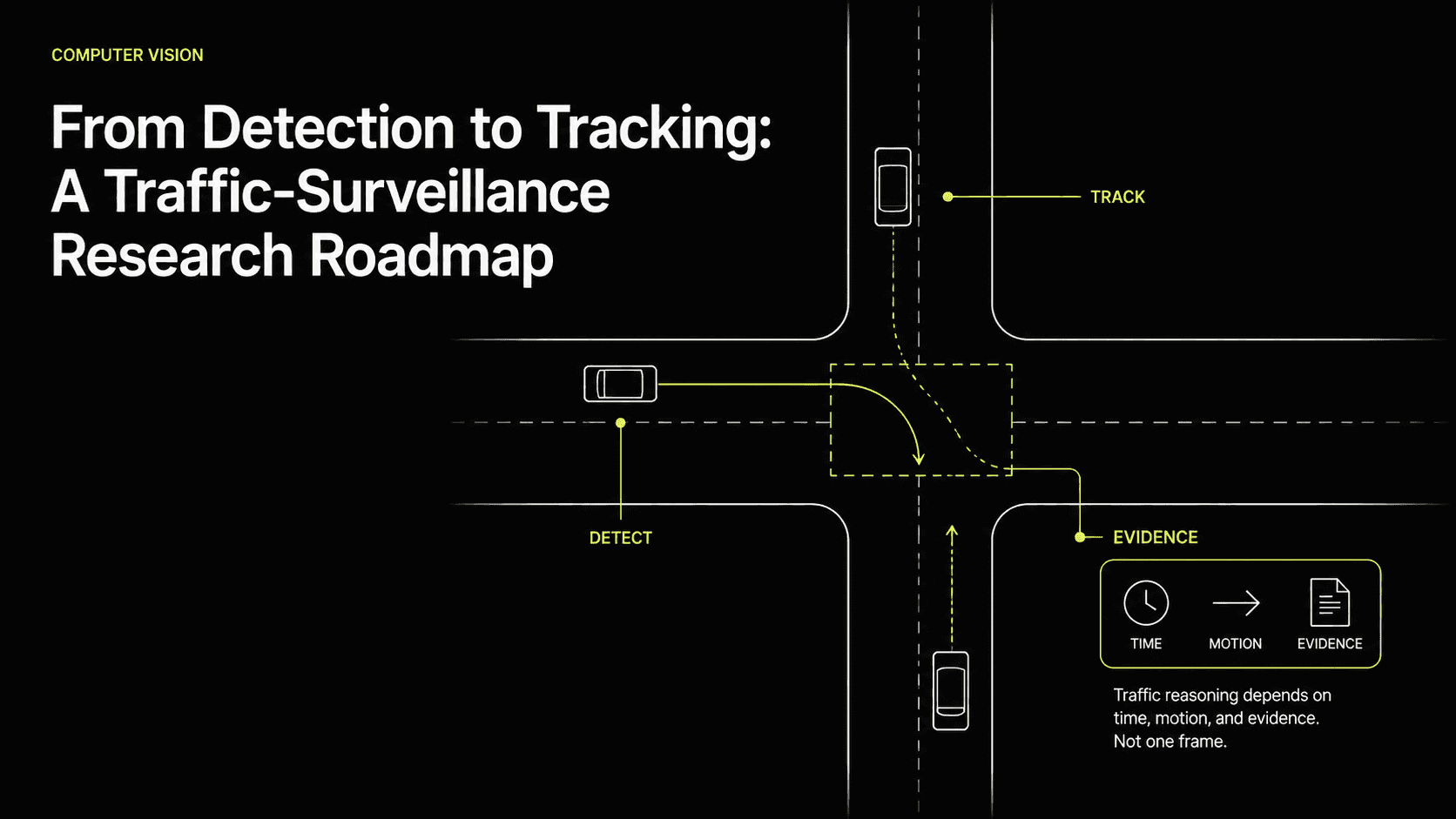
From detection to tracking: a traffic-surveillance research roadmap
Object detection answers a useful but narrow question: what is visible in this frame? Traffic safety questions demand more. Did two vehicles approach one another? Did their trajectories converge? Was there a sudden change in motion? Can the system preserve enough evidence for a reviewer to understand the event?
That is why MS-ADA is designed as a temporal evidence pipeline rather than a single-model claim. Detection, tracking, optical flow, plate recognition, and event capture each contribute a different signal. The research value comes from how those signals are combined and audited.
Stable identity changes the problem
Frame-level boxes cannot tell a credible story on their own. Persistent tracking makes it possible to measure direction, speed change, relative proximity, and post-event separation over time. Even then, identity switches and occlusions are not edge cases. They are central limitations that should be reflected in confidence and evidence design.
For a CPU-first academic prototype, interpretable signals are especially valuable. A deterministic temporal rule can be inspected, stress-tested, and improved when it produces a false alert. That is often a better research foundation than an opaque score with no explanation.
Evidence is part of the model output
An alert should be accompanied by the frames, short clip, trajectories, timestamps, and contributing signals that made it worthy of review. The system should describe an event as a candidate for human review, not a final legal or safety conclusion.
This distinction protects both the research and the people represented in the footage. It keeps the claim proportional to the evidence: a prototype can surface plausible incidents and preserve context, while still being explicit about deployment limits, data diversity, and evaluation scope.
Where newer foundation models may help
Vision foundation models widen the research options. Meta's SAM 3 supports promptable detection, segmentation, and tracking in images and video. DINOv3 shows how strong frozen visual features can support downstream dense tasks with lightweight adaptation. Neither removes the need for local validation, but both are interesting routes for improving masks, associations, and domain transfer.
The research question is not simply "which model is newest?" It is whether a model improves the evidence pipeline under the actual constraints: video quality, camera angle, computing budget, failure recovery, and reviewer understanding.
A responsible next phase
Future work should evaluate scenes with diverse lighting, weather, density, camera positions, and local traffic behavior. It should measure detection and tracking quality separately from event-reasoning precision. It should also compare false alerts, missed events, latency, and the clarity of the generated evidence package.
The goal is a defensible research system: one that makes its inputs, temporal signals, uncertainty, and limitations visible. That is more valuable than promising universal accident detection before the evidence exists.
The MS-ADA pipeline in practice
The MS-ADA case study combines YOLO11 detection, persistent tracking, ALPR, optical-flow signals, and evidence outputs. Its accident reasoning is deliberately multi-signal: contact or proximity, relative motion, deceleration, trajectory convergence, and optical-flow change are considered over time. A candidate event triggers preservation of processed video, snapshots or clips, and event records for review.
That is a stronger engineering posture than treating a single overlapping box as an accident. Overlap can be caused by perspective, occlusion, or an ID switch. The output is therefore an event candidate with evidence, not a confirmed incident or a claim of universal accuracy.
Research boundary. The canonical reviewed run is evidence for the prototype and its regression behavior. It is not a claim about every road, camera angle, weather condition, or traffic pattern.
Tracking is where the assumptions surface
Persistent IDs make trajectory and deceleration features possible, but they can fail during occlusion, crowding, and appearance changes. Plate recognition is useful evidence when readable; it is not guaranteed identification. These are exactly the places where a human-reviewed ground-truth set and explicit false-positive analysis matter more than a headline accuracy number.