Build Agentic AI That Can Be Debugged
An agent is a stateful workflow with tools and side effects. Design it so each decision can be inspected and bounded.
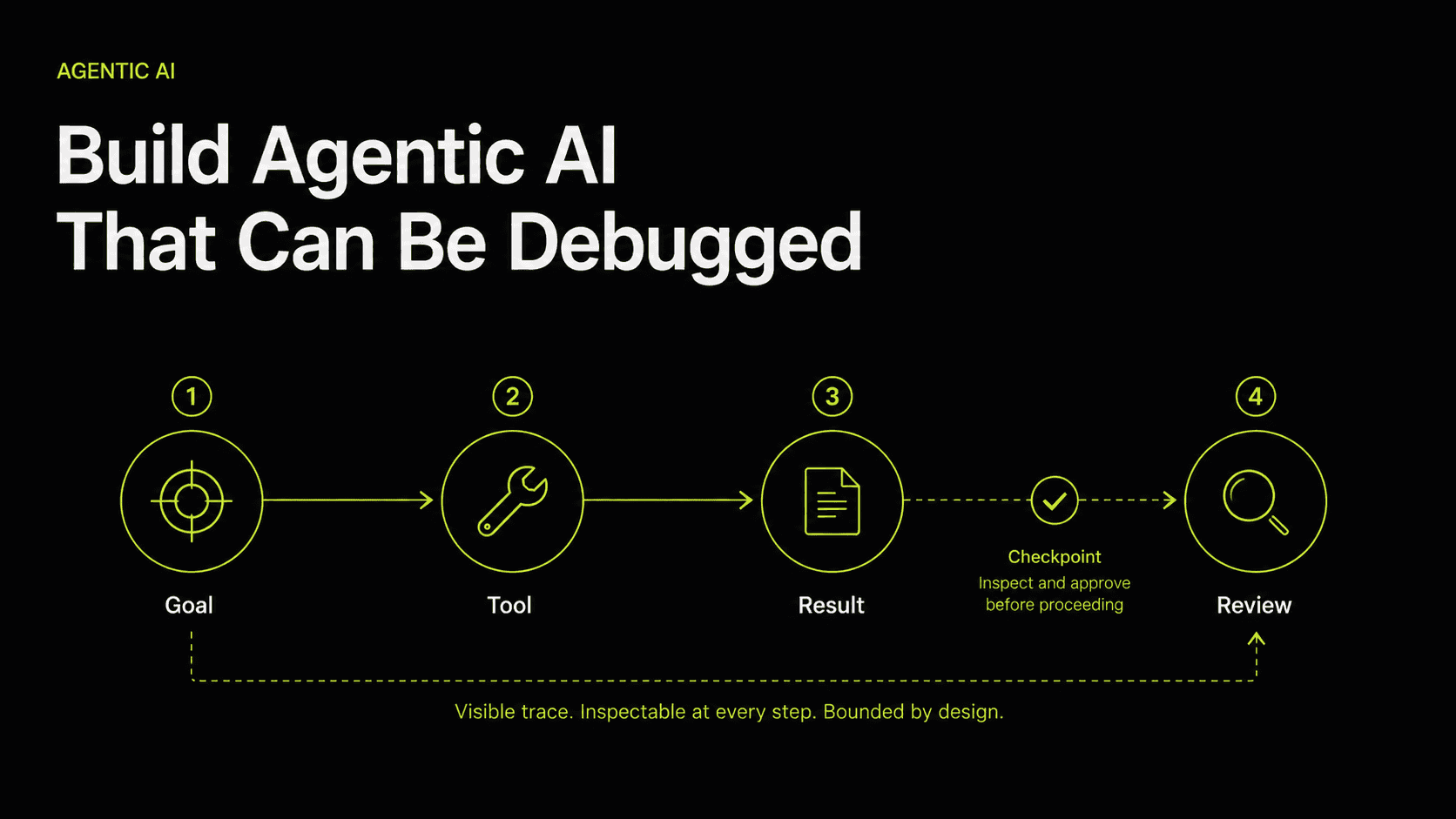
Build agentic AI that can be debugged
The moment a language model can call tools, carry state, and affect a system, it is no longer just a chat response. It is a workflow. Workflows need boundaries, traces, failure handling, and tests.
The most useful mental model is simple: an agent proposes the next action, but the surrounding system owns authorization, execution, persistence, and evaluation.
Make the loop visible
Every run should have a trace that answers five questions: what was the goal, what context was available, which tool was selected, what did the tool return, and why did the run stop? Without that chain, an agent failure turns into a vague claim that "the model got confused."
The OpenAI Agents SDK announcement highlights tracing and guardrails for exactly this reason. Observability is not decorative telemetry. It is how an operator learns whether the failure was an instruction problem, bad retrieved context, an unavailable tool, an unsafe action, or an incorrect model decision.
Keep tools narrow and typed
A broad tool like manage customer account creates a giant ambiguity surface. Prefer small tools with schemas that reflect a real permission boundary: get invoice, draft refund request, submit refund after approval. Validate arguments on the server, return typed results, and keep writes explicit.
The model should never be the only authorization layer. It can propose a tool call, but the application should enforce identity, tenancy, rate limits, policy, and idempotency before any side effect occurs.
Use checkpoints, not endless autonomy
Most useful agent tasks are short chains with clear stop conditions. Set a maximum number of turns, a time budget, a tool budget, and a definition of success. For consequential work, insert a human confirmation or a deterministic policy gate before committing the action.
This is also good product design. A user can understand "I found three matching records and need your approval to update one" much better than an opaque progress animation.
Evaluate trajectories, not only answers
An answer can look good while the agent used an expensive or unsafe path to produce it. Evaluation should include tool selection, argument validity, action order, policy adherence, recovery from tool errors, and whether the run stops when it should. Keep fixtures for both successful and intentionally blocked tasks.
I like a layered release gate:
- Unit-test tool schemas and deterministic policy.
- Replay known traces against changes to prompts or models.
- Grade a small set of task trajectories.
- Review sampled production traces with sensitive data redacted.
The useful constraint
Agents become more trustworthy when their freedom is designed, not assumed. A narrow tool surface, observable reasoning path, finite budget, and explicit handoff make the system easier to improve without pretending it is infallible.
A debugging sequence I would actually use
Start with the smallest reproducible run. Capture the input class, permitted tools, tool arguments, tool result, state transition, and final disposition. Then ask a deterministic question at each transition: was this tool allowed, were the arguments valid, did the tool return the expected shape, and did the state machine take the permitted next step?
For example, a document assistant can propose a retrieval call, receive an empty evidence set, and stop with a request for a better source. It should not continue into answer generation merely because another model turn is available. That same boundary is used in the PDF RAG Chatbot: insufficient retrieval evidence produces an abstention before a provider call.
Limitation. A trace explains what the system did. It does not prove the decision was correct. Evaluation still needs representative tasks, blocked actions, tool failures, and reviews of whether a valid tool call was the right action.
Keep sensitive context out of the trace
Useful traces record identifiers, decisions, durations, status, and safe summaries. They do not need to store secrets, raw credentials, or complete private documents. Logging policy is part of the tool contract, not cleanup to add after an incident.